
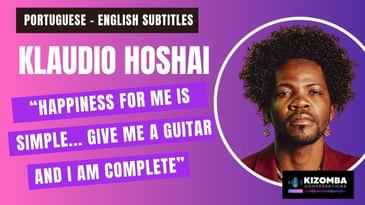


Klaudio reflects on his successful songs, including 'Pio Pio,' and emphasizes the richness of African music and its cultural significance. In this engaging conversation, Klaudio Hoshai shares his personal journey as an immigrant in Europe, reflecting on the challenges and realities faced by those who leave their homes in search of a better life. He discusses the inspiration behind his music, particularly his song 'Mea Culpa,' which addresses themes of forgiveness and connection.
Klaudio emphasizes the importance of humour in his performances and the need to stay connected to one's roots and culture. He expresses his mission to use art and music to spread love and understanding, while also highlighting the collaborative efforts to promote African music in Portugal.
To connect with Klaudio, check him out on:
Instagram: @klaudio_hoshai
TikTok: @Klaudio_hoshai
Facebook: Klaudio Hoshai
Youtube: Klaudio Hoshai
Klaudio's Representation:
MM Intermedia
Instagram: mm.intermedia
Klaudio's Songs:
Pio Pio - https://www.youtube.com/watch?v=jmaAu3KqEd0&list=RDjmaAu3KqEd0&start_radio=1
Emigrou - https://www.youtube.com/watch?v=8G-Hj9TJPOY&list=RD8G-Hj9TJPOY&start_radio=1
Mea Culpa - https://www.youtube.com/watch?v=kvackFGdBGQ&list=RDkvackFGdBGQ&start_radio=1
Follow us:
Visit our website: https://kizombaconversations.com/
Connect with us on Instagram: https://www.instagram.com/kizombaconversations/
Connect with us on Facebook: https://www.facebook.com/kizomba.conversations
Chapters:
00:00 Introduction to Klaudio Hoshai
01:43 Klaudio's Roots and Early Influences
04:15 Musical Journey and Growth
10:28 Artistic Development and Influences
11:22 The Role of Family in Music
13:14 Musical Inspirations and Cultural Identity
17:42 Training in Paris and Artistic Growth
21:23 Klaudio's Musical Successes and Future Aspirations
22:47 Live Performance and Songwriting Process
24:27 The Story Behind 'Pio Pio'
34:13 The Global Reach of Music
37:11 The Immigrant Experience in Music
44:13 The Power of Music in Communication
46:14 The Evolution of Klaudio's Music
48:13 The Role of Apology and Forgiveness in Art
53:40 Connecting with Audiences Through Humour
57:19 The Purpose of Art and Cultural Representation
TAKEAWAYS
Klaudio Hoshai is a musician from Angola with deep roots in his community.
His early exposure to music came from family, particularly his father.
Klaudio faced rejection in his early singing career but persevered.
He gained experience by performing in bars and connecting with local musicians.
African music is a significant influence on Klaudio's style and creativity.
Kizomba and Semba are vital parts of his musical identity.
Klaudio emphasizes the importance of blending modern and traditional music.
His training in Paris helped him refine his artistic skills.
Klaudio believes Africa's musical heritage is rich and under appreciated.
The success of 'Pio Pio' marked a turning point in Klaudio's career. It's a message, it's a record, it's a memory.
People who leave their land look for better living conditions.
Being far from home is psychologically impactful.
Integration difficulties can lead to deep reflections.
Music can help convey messages to family back home.
Forgiveness is a theme that resonates in modern society.
Humour helps connect with the audience on stage.
Art should reflect where people come from.
The mission is to spread love through music.
Collaboration is key to promoting African culture.
SOUND BITES
"I started rapping as every teenager did."
"I didn't have a voice to sing."
"Music is music and there is no age to it."
"Pio Pio was an experimental song."
"I wrote that song in about 20 minutes."
"The production was amazing."
"This song takes me to concerts."
"It's a song that's not just a song."
"Life in Europe is not easy."
"It's about requesting forgiveness."
"I chose to bring the humor."
"It's a crime to ignore the roots."
"Art has to bring that."
"I want to make timeless music."
"I could get on a plane, I could sing."
TRANSCRIPT
(00:14) Adel
Well then, dear listeners, welcome to another Kizomba Conversations episode. As you can see, and likely have already realised I'm not Victor. We have a super special guest for this edition and the guest, because of who he is, we want this authentic. So let's do our conversation here in Portuguese.
Now introducing our guest, Klaudio Hoshai. Welcome, thank you very much for taking the time to have a conversation.
Klaudio Hoshai (00:50)
Ok, thank you very much Kizomba Conversations, we are here to share this beautiful moment.
Adel (00:55)
Exactly, wonderful, wonderful. Klaudio, The first point here is to understand a little about you and your roots. Starting then, who is Klaudio Hoshai? Tell us a little about you, where you grew up and how your life in Angola shaped you.
Well, Klaudio Hoshai is a musician born in Angola, precisely in a neighborhood of the municipality of Manhanga, which is called Calemba. For many, it is the neighborhood of the bullfighting, because it is known by this name, it is a neighborhood within the Community of Cassequel. Well, that's where I had my childhood and then I went to live in Malanje, where I finished my studies and is where I started to dedicate myself to art. I only started to contact art even in Malanje, not necessarily in Luanda. In Luanda I had some cousins who are artists who left Malanje . I'm not the only musician in the family, there are other musicians too, but when they left Malanje they went to live at my parents' house and I came into contact with art just by watching and my performing was in the province of Malanje.
Adel (02:14)
At that time, how old were you Klaudio?
Klaudio Hoshai (02:17)
At the time, in Malanje I was 17 years old.
Adel (02:22)
You were at an age already... Yeah,
Okay, okay. So you found the art, you found the passion.
Klaudio Hoshai (02:30)
Yes, I started rapping as every teenager did. We started listening to rap which is a music genre very influential in puberty so I started rapping. Then I joined the choir of the church, where I started learning to sing with notes, I learned to play the guitar, and that's how I started singing and making music.
Adel (02:59)
Ok, ok. By the way, now I remembered, going back a little before we continue on this path, your name, a curious name, what is the origin? Hoshai, right? Klaudio
Klaudio Hoshai (03:05)
Mm-hmm.
Klaudio is my name on the record, but I had to put the 'K' on to have this distinction because there are many Claudio right? with 'C'. So, 'Hoshai' comes from a word in the Kimbundo language. It's an inflection of Kimbundo, which means 'that belongs here', or 'is ours'.
Adel (03:16)
Okay.
Yeah, the difference.
Yeah. Yeah.
Okay, yeah, yeah. Okay.
How was your journey? As you were saying, the fact that you started in the church choir and playing the guitar, tell us a little more about it, how it was and your progress in that journey.
Klaudio Hoshai (03:52)
It was funny but also good to say that sometimes, in the first impact with people who understand the subject, we are rejected, we are excluded, but we have to be persistent and continue to make the other person understand that we have the talent to do this. When I entered the church choir, the master
Klaudio Hoshai (04:20)
of the choir there in the church, he said I didn't have a singer's voice. So he put me on the bass, as if to hide me in order not to stand out.
Adel (04:33)
He put you behind to go unnoticed.
Klaudio Hoshai (04:35)
On the bass,
As others in the group already had a singing voice, the bass, because it requires a consistency with a lot of presence, I was muffled there in the back, amongst all those voices, imagine that. When you're in the bass, almost no one hears you. The most prominent voices are always tenor, baritone, and tenor.
Adel (04:50)
Yeah, yeah.
Klaudio Hoshai (05:00)
I couldn't do soprano because the girls were on soprano and the boys were on the tenor. I always had a high-pitched voice but as he said I didn't have a voice to sing. I stayed in the base but I wasn't happy with the voice I was making. So, I left the church. I quit singing in the choir. I attended the church but I quit singing in the choir and signed up for a music competition.
Adel (05:26)
Okay.
Klaudio Hoshai (05:27)
Where I sang a song by the Italian musician Andrea Bocelli. I imitated Andrea Bocelli at the time and the jury, looking at me, said, "Do you sing in the choir?" I said, no, I don't sing in choir. I had early lessons in the choir and they said I didn't have the voice to sing. "No way...
Adel (05:32)
No way. Wow!
Klaudio Hoshai (05:52)
"You're one of the preferred candidates to be in this casting!" So imagine, in Malanje, usually the songs that are sung are more folkloric, more songs from Africa, or imitating Tabanka Djaz, or Don Kikas or I don't know. So, there in the competition of the 'Estrelas ao Palco'
Adel (06:08)
Yeah, see, see.
Klaudio Hoshai (06:17)
I started imitating Andrea Boccelli and I was one of the most feared candidates. I competed in the first, second and third editions. In the third edition I got to the semi-finals. Unfortunately, I didn't win the contest. Sometimes, winning isn't everything. So, in the following year, which was the fourth year, I was invited to be part of the jury...
Adel (06:44)
Wow.
Klaudio Hoshai (06:45)
in that same competition I came back because I left out as a highlight previously. In the province, people were talking about me because I had a powerful voice and made it to the semi-finals. When I came back to the church choir, I returned as the director of the group.
Adel (06:50)
See you
Yeah?
Klaudio Hoshai (07:09)
It's the dedication I had. I didn't back down, I continued to work. Even when I wasn't part of the church, I continued to work, to investigate music. Even in the competition we had singing classes; I started to improve more and more. And when I returned to church, I came back as a person who understood the subject and I was no longer put in the base. I was the person managing the voices.
Adel (07:33)
Of course. At that time, you had not yet undertaken the training in Paris.
Klaudio Hoshai (07:40)
Not yet, not yet,
This was in 2007, 2008, 2009, 2010. I finished my studies, I lived in the countryside of Angola, then I went to Luanda, where I was born, and I started performing in bars and restaurants. So I started to improve myself on the guitar, share skills, and listen to more songs.
Adel (07:54)
Yeah. See, see,
Klaudio Hoshai (08:09)
Meanwhile, I started to connect with local musicians from AVC (Angola Video Clips) and producers, and they saw that I had a talent to compose, which I brought from rap, because rap is a style of music that gives you the skill to do freestyle, which is like doing a verbal essay where you develop that theme without deviating from it.
Adel (08:14)
Yeah. Yeah.
Yeah.
Klaudio Hoshai (08:37)
So I started to have this ability and when I traveled to Luanda, they saw that I had the ability to compose. I presented some of my own work and that's when I entered the world of music, making songs for other artists. That's how the journey went.
Adel (08:37)
Yeah.
How was that experience? How did that shape you, prepare you for your own personal career?
Klaudio Hoshai (09:05)
Well, the contact with professional musicians who have had a long career, and continue to have because they still exist, that socialisation began to bring me artistic maturity...
observing how they positioned themselves on stage, how they record the voices on the microphone, how they record the voices. I started learning with them, although I was still in bars making music, singing in restaurants and bars. I started to understand the world of music from a much more open angle and have the ability and in a way gaining responsibility for myself as well to sing my own songs.
I gained a certain maturity that today, even though I haven't been on big stages yet, I already have a vast experience because of the interactions I had with those artists, who throughout this journey shared their experiences with me.
Exactly. This is one of the things that I find very beautiful about art - it molds, and educates, especially music.
Adel (10:18)
Yeah.
Klaudio Hoshai (10:21)
It changes your character, the way you deal with society, the way you behave in public. So I have this privilege of being part of this artistic world because today if I'm Klaudio Hoshai, besides the artist it's art, thanks to music.
Adel (10:41)
And the way of thinking also changed during this period. Speaking of influences, what is the first memory of music that you have even if it wasn't singing, but first memory that really stuck with you in musical terms?
Klaudio Hoshai (10:44)
Well, I usually say that my music teacher wasn't the one who taught me the do, re, mi, nor the vocal technique. My first music teacher was my father. who has already passed but...
He was my first teacher because I started learning, and all those songs that I play with so much love, so much soul, are things that I absorbed from him because I stayed at home. At that time they were cassettes and we had to rewind the cassettes when there was no light at home. We used the pens to turn the cassettes.
Adel (11:32)
Yeah, yeah.
Yes.
Klaudio Hoshai (11:44)
And I was exactly that rebobinator. I would select the tapes and play them we even knew the places where the song number 3 was, for example
Adel (11:48)
Yeah, yeah, yeah. Yeah.
Klaudio Hoshai (12:01)
So these things that really marked me. My father was my first teacher and I listened to music, from folk songs from Malanje which were his region's Congolese songs, mainly Congolese and Cabo Verdean songs, because it was a time when we were at war. And there wasn't much possibility of having songs made in Angola. It has more music, Tabanka Djaz,
or Cabo Verde, Jorge Neto or Congo. These were the musicians that were popular in Angola. So I learned and got these musicians through my father. All the musical influence, all the artistic know-how I have is thanks to my father. For me, he was my first teacher.
Adel (12:31)
Yeah. Yeah. Yeah.
Speaking of this influence, Klaudio...
The impression we have of the music you produce is that it really has different influences, such as jazz, blues, afro... Zouk too, for example, how is all this combined? And what inspiration do you have? Where do you get inspiration to really produce this magic?
Klaudio Hoshai (13:13)
Well, first of all, a very strong part that I have in my musicality, without a doubt, is African music. I love African music; in fact, we are very rich in terms of rhythm and melodies. We have rhythm and we are one the strongest in the world, of course, African music is the pivot of world music, therefore...
First, African and precisely even in Congo, where one of the musicians that I admire is Lokua Kanza, I don't know if you've heard of him, a musician who has a very Afro-Afro style mixing jazz with our traditions. So this is my first point of absorption.
Klaudio Hoshai (14:07)
Of all the artistic absorption that I have of Africa then I started to know other things, like World music, Jazz, R &B. So I mixed all that, modernity with the more classic African music and brought this Klaudio somewhat different.
Adel (14:09)
Yeah, I'm realizing,
For our listeners, who may be new to this type of music, especially to kizomba and Semba, how do you describe kizomba and Semba? What message would you send to these people who are new to this music style?
Klaudio Hoshai (14:34)
Mm-hmm.
Well, we still have this problem, it's something I need to talk about because it's a record, mainly for Angolans, that labels the styles we have, which are very identity-focused, mainly the Semba. Some call it old-people's music, old-style in fact there is no old-style music. Music is music and there is no age.
Adel (15:17)
Yeah.
Klaudio Hoshai (15:19)
So many feel ashamed and feel the fear of doing this style that identifies us, which is Semba. And I, as young man, have been following this path firmly and showing the world our culture, our musical identity So I keep following this path because I want these people of my age to continue to spread and sing what belongs to us - what is rightly ours , which is African music, so that other parts of world come to know this beauty. So this is my statement in art. And with Kizomba the same thing, although Kizomba appeared in the 90s only, then started to proliferate, but the most traditional one is older, right?
Unfortunately, young people today follow the trend of modern It's not that it's wrong, but if we make a mix of modern with traditional and classic music from our home we can bring to the world something different. They could be more interested in what belongs to African music. So this has been my job, to continue making beautiful music in Semba and Kizomba for other people who are getting to know a new Klaudio . They don't look only at Klaudio, but rather at Angola and Africa, because of this cultural beauty we have.
Adel (17:09)
Speaking of music, let's move to another topic as we've started to cover that theme anyway.
We spoke briefly before about your formal studies in Paris. The voice, the piano, the stage that we talked about a little. How was that training and what are the areas that gave you the most advantage?
Klaudio Hoshai (17:40)
Well, I think, without exaggeration, I will talk about the Art School in Paris. I think God gave a very special gift to the Africans, precisely in art. When I arrived at the academy in Paris, in the classroom,
The teacher asked where I learned and I said I didn't go to music school and he saw how I sang, how I used my voice, how I used the guitar, how I used my chords.
with a lot of sentiment, with lots of Africanity. He said, "you never went to a music school?!" I said I never went to a music school. I learned like this, with friends on the street, with cousins who also made music and normally we don't have the conditions to have many music schools in Africa. We learned like this, this way, more traditional.
They were sincerely astonished 'how come you don't read sheet music and play the guitar like that? Because normally in music school there are the rules; It's theory and practice, but it's with papers, it's all mechanized. You have to read sheet music to play it precisely. And we Africans, thank God, don't need that.
Klaudio Hoshai (19:06)
even though our music is very complex. This complexity that was brought to the classroom was what made the teacher admire me, Africa is the very cradle of humanity, and I was feeling privileged by these words and I saw that we are very rich in terms of art.
Adel (19:09)
Do you think the world has already realized that Africa really has this wealth or are there a lot of places that haven't understood this?
Klaudio Hoshai (19:38)
Well, I think the world has already understood. As always, we have a global structural problem. They know that almost everything came from Africa. Jazz itself and other things were spread and taken by African slaves and people who even taught artistic etiquette were Africans. They know, but sometimes, unfortunately, they try to omit what is obvious.
Adel (19:51)
That's sad.
Yeah. Africans.
Klaudio Hoshai (20:09)
But, yeah, we have been doing and showing the opposite with the talents that have been born every day in Africa and that have given lyrics to the world. We have several big names in the world of music. In fact today African music is the center of the world. Everyone is in the trend of African music, everyone listens to African music so I think there's nothing more to prove. It's just a matter of acceptance.
Adel (20:31)
Exactly, absolutely, What I see is that people sometimes forget to open up, be willing to learn and pay homage to this art that is here. It is not a visual art unless you are dancing. It's a different kind of art.
Klaudio Hoshai (20:50)
It's true.
Adel (20:59)
Speaking of art, you probably have realized that this touches me deeply. Let's talk a little bit about your successes up to date and we hope there will be many more in future. Let's talk a little bit about your songs. And I would like, Klaudio, that you give us a little taste of your music for our listeners.
Klaudio Hoshai (21:22)
Before I go into my songs, I will try to bring a Klaudio from Metamorphosis, that Klaudio who absorbed the first songs and learned to make the music by means of influence of these songs. I really like to sing songs, the songs of the Angolan musicians to be even more identifiable so that people can understand where I'm from.
Adel (21:44)
Okay.
Klaudio Hoshai (21:56)
I made this effort as a young man. It's important, although some feel ashamed, but I feel privileged to be African and have a rich culture and show the world that modern music is not ugly, but folk music has much more beauty. Because all these more modern ones come from that. Exactly, so I'm going to try here.
Adel (22:17)
Exactly. Exactly.
Klaudio Hoshai (22:25)
I really like a song called Desespero. It is a song by an author called Robertinho who is a pillar of Angolan music too.
KLAUDIO SINGS DESESPERO
Adel (22:41)
Yeah.
Yes Wow! I have no words! Wow! I feel privileged to have heard you Klaudio. I know the song. And Victor is here and says absolutely spectacular! Klaudio, thank you so much for that!
Klaudio Hoshai (23:39)
Obrigado, eu. Obrigado, eu.
Adel (23:45)
Really to be live to hear you. Our dear listeners hope you are enjoying this impromptu song here from Klaudio. Talking about music, one of the most famous of yours is Pio Pio. For me it was the first song I heard. I fell in love when I heard it. I would like to know, and I know that many listeners do too, what inspired this song, what it means and what you think it conveys to people when they are listening?
Klaudio Hoshai (24:37)
Pio Pio. Sometimes we do something that we don't know what the result will be. Pio Pio was an experimental only experimental song because I had never done Semba or Kizomba. And I met a cousin who is the guitarist for Yuri da Cunha for many years Texas you've probably heard of him he's a guitarist he has a song, he's been playing called "Choro of Semba", which is a very beautiful song so he made me become fond of Semba and Kizomba. He said Klaudio , you have a very beautiful voice. I like hearing you sing R & B. I like But let's go.
Klaudio Hoshai (25:26)
To try a song, it has to be Semba. I said, no, this song, Semba, is a lot of responsibility, I won't be able to do it. I won't be able to do it. He said no, you'll be able to do it. Think of a song. And we're going to record. It was a time when I didn't make music anymore. It was a time, practically, when I was almost depressed because I had a lot of disappointments in art, many promises of producers and musicians they said they could support me to make it work, but unfortunately things didn't happen as I expected. That made me very discouraged. I stayed more than five years without singing, without playing the guitar, without playing anything. I started working on something that had nothing to do with music. I went to a supermarket where I was cleaning up in that supermarket and I didn't want to do anything to do about music
And in 2017, Texas came to me with this proposal. He said let's try it one last time. If the song doesn't work, you move on with your life. Because I wanted to leave Angola to study music. Studying music had been my intention so I forced and fixed on that thought to leave Angola and study music. So he said, Klaudio, let's try to do something.
Okay, Let's invest in a song, but it has to be Semba. So I went home. Pio Pio is something I wrote in about 20 minutes. The chorus already existed, I just didn't have any lyrics
Adel (27:10)
Okay.
Klaudio Hoshai (27:22)
It's a joke. I'll take this joke, I'll try to create some scene here to see if we take the guitar, I create the chords. I usually create the first chords. I'm not very good at writing in notebooks. It limits me a lot. I like to record the melody. For example, And then, on top of that, I start putting words. I take the guitar and start putting words.
Adel (27:28)
Yeah. Yeah.
Klaudio Hoshai (27:50)
I don't write on paper. Not even one of my songs is written on paper. I design it in my mind, then grab my phone and record the melody and then I start adding words. So, since I already know this rap of creating songs, the next day I went there and Texas organized an orchestra. There is no other name because they are Angolan.
Adel (27:52)
Okay.
Yeah.
Klaudio Hoshai (28:16)
I went to the studio with my guitar to show him the song and he was in the studio with Lito Graça, with Nanoto, Joãozinho Morgado, it was like having Messi and Cristiano, Ronaldo all in the same place. And then we started to create the song, he produced it. He is an excellent guitarist, Cota Nanoto, is one of the greatest saxophonists we have in Africa.
Adel (28:32)
Wow.
Klaudio Hoshai (28:46)
And of Semba, and plays it very well. He also helped the cause and everyone performed the song without asking for anything. No one charged anything. Everyone was available to help me record my first song. I think the song is a success not because of the voice, I think it's because of the production. This whole team that was involved to perform this beautiful song from the arrangements of guitars, woodwinds and drums, it's something very beautiful. These gentlemen, Joãozinho and Morgado, we can consider as a legend of percussion in Angola.
Because he is one the prominent names in percussion when it comes to Semba, Joãozinho Morgado and the bass player Carlitos Chiemba. So these people who were part of the production of the song and success, started playing outside of Angola, not in Angola.
The success started first outside Angola, then Angola, then other cities. I did it jokingly and said, let's see where this song will reach. I didn't give much thought in the song, I did it and went on with my life. I didn't share with friends and I left Texas in charge of it. And we upload it on digital platforms Only Like MediaFire, ok?
The song reached the Kizomba dance floors. We started receiving videos from France, Belgium, Luxembourg, we started receiving several videos of people dancing to music and the music went viral!
Adel (30:27)
completely, completely, wow!
What a story! This whole plot came to enrich this song even more. I think for the listeners it will be even greater, even richer with this story.
Klaudio Hoshai (30:39)
Exactly. Today It's the song that gives me concerts. That is, whoever knows Klaudio Hoshai today and respects my musicality is through Pio Pio. A song that I didn't even pay much attention to at the time. And today is the song that takes me touring around Europe.
Adel (31:00)
That which is least expected is what brings the biggest or at least the beginning of a greater thing. Wow! Yes,
Klaudio Hoshai (31:05)
Exactly, it's true.
Now let me show you the sounds.
Adel (31:19)
Mm-hmm. Okay.
KLAUDIO SINGS PIO PIO
Adel (33:33)
Yes, man! Yes, man! One more! And Victor is saying, wonderful! Wow! Wow! Yes, man! Hearing this live of course! This song is beautiful and with this story that you told us here about how it was created, Thank you for that.
Klaudio Hoshai (33:53)
We are doing some work so that people associate this song with me., because it has gone very far. The music of Pio is music that for me in the world of kizomba, and semba, doesn't need any presentations because I've heard people sing with me even in Poland. They sing Pio with me in Romania, they sing with me in the Netherlands.
It's a song sung in Portuguese, and yet they sing along. They don't speak Portuguese yet they sing along with me. I'm speaking in Portuguese, I'm singing it with you. But there are people who don't associate the image with the music. Therefore, we need this work, to have a video with sounds and a fresher Klaudio Hoshai image to associate with because there are people who, even at this exact moment, continue to look for the musician of this song to maybe provide a concert or something and they know who the artist is Maybe they cross paths with me and don't associate that the other songs they like are mine. Right? Pio Pio part of They don't associate, they don't know who the artist is. So we're here to draw a purpose to make a video clip in height so the artist's will reach where the song has.
Adel (34:59)
Yes sir, and do you have an idea of when we can expect this video
Klaudio Hoshai (35:16)
Will be... something soon. We are trying to this moment.
and that's what we're going to achieve because the purpose is that we have to grow. Our music goes and our image has to be at the same speed as the music. Music is already a spaceship but now the artist needs to take advantage the music that it has been having lately because the music is not getting any better, it's been 10 years since that music. 10 years of Pio Pio.
Adel (35:50)
Yes yes sir,
yes sir!
Klaudio Hoshai (35:52)
So, it's a song that you liked, I didn't think it could have that success in music and I'm surprised too, I'm happy when I meet people from other nationalities singing the song.
Adel (36:07)
It's a journey song, certainly, and that will spread even more, I'm sure I speak for myself and certainly for our listeners too. We are anxious to see the video and continue to be present, to watch your success. Success does not come without effort, without work, without dedication, like everything you've explained to us and that takes us here to another song.
Klaudio Hoshai (36:12)
Thank you.
Adel (36:34)
Another song that is also a success is Emigrou. Tell us a little bit about this, Klaudio, what was the inspiration? This is a song that reflects the struggles you had too. What does this song represent for you?
Klaudio Hoshai (36:51)
Well, it's a song that is not just a song. It's a message, it's a file, it's a memory, and it's something for myself and for all immigrants, no matter the color.
to reflect on being able to understand the subject. In fact, it's a story of mine that I started to live from the moment I stepped into Europe. I'm very new in Europe, since 2020. In the meantime, you imagine that people who never left their land...
and leave to look for better living conditions, not prepared, not knowing how things work and...
How can I say this? Few people are able to direct, few people are able to teach, psychologically inform them of integration. Feel in a country, far from your own, and especially for Africans we are very affectionate. We are connected to the family from birth to the day we leave.
African people in general are not very keen on immigrating. So this difficulty of you leaving the place where you are, where everyone is family, even your neighbor, and you come to a place where people are different, and we are because we are in a different place, made me reflect on this and also...
Adel (38:33)
Yeah.
Klaudio Hoshai (38:42)
I was struggling for a long time. The work for me was a work on my own, regardless of the difficulties, but I could give up on this type of work. Then was integration, skin exclusion, racism.
Adel (39:09)
Yeah,
yeah, yeah.
Klaudio Hoshai (39:10)
In various places, difficulties in the treatment of documents. So that made me reflect deeply and that day I was working at a construction site in the company and I was with a friend and then..asking him for a building block and I don't know I came up with the melody. At that moment, the concrete mixer was making a noise, those loud ones, and then I got just one part. I stayed there 3, 4, 5 months, but then, when I left work, because of the boss he didn't want me anymore. So I wrote the song, I took my guitar, I looked for a melody and I did that.
KLAUDIO SINGS EMIGROU
Adel (43:43)
Wow! Yes, man! Yes, man! Klaudio, have no words! Wonderful! What a show! What a musical Yes, man!
Klaudio Hoshai (43:54)
Thank you very much. The song was made to help relatives families who stayed in Africa, to understand life in Europe is not easy. It's not like you leave your home and travel then you become a millionaire and have a lot of money because many times we are...
Klaudio Hoshai (44:17)
We don't have things and we don't spend the time they want. And they think we don't want to support them.
We are very supportive and we are here to help the relatives, even the most distant. And when we don't support them, especially at the right moment they think we don't want to support them. But no, we have to pay for the internet, the house, the transportation, the clothes, and food, at the end of day you don't have money left. You work to pay the expenses. So it has been very difficult. So this message for those back at home to understand that life in Europe is not easy.
Adel (45:11)
Many times we immigrants don't have the capacity to send this message to our family and friends. With music we can at least understand that we are not alone. Absolutely, Again, wonderful, spectacular, spectacular. Speaking of music, we are on the subject of music and we have already heard three wonderful songs of yours and we have another one.
Klaudio Hoshai (45:20)
It's true. Thank you very much.
Adel (45:40)
That came out last month. 'Mea Culpa' give us a little bit the taste of this song's music and tells us also, the inspiration and how it was created, and the history of this song.
Klaudio Hoshai (45:42)
Mm-hmm.
BANG!
Well,
Mea culpa has a history of more than 20 years. It's one of the oldest I know. It's not written by me, it's actually written by a friend more like a brother.
and I was present at the composition of the song and he forgot about it. and it was one of his songs that I liked and he stayed with me for 20 years in my heart and I sang and then I said, it's time that I also should present one of the oldest songs or that more juvenile version of Klaudio Hoshai so people don't recognize and associate me with only one type of music in one type of music a record. I want to show my versatility to this song. So I will go and ask the original song writer to let me sing the song's theme, because he had forgotten the song. And I am very much the filter of my friends. All of them who have songs that they've already forgotten, maybe I have them. I could do some crime here, record all of them and claim it's a composition of mine, but no, it's from Leoncel. As there is also a theme.
Adel (46:50)
Yeah
you
Klaudio Hoshai (47:08)
It’s important and that draws lots of attention and generates several themes, several sub-themes, which is a request for forgiveness, the half-blame. Lately we...
we are entering a phase, in the 21st we are in a phase where pride speaks louder than education, than principles, than civic morality. Sometimes we fail with these people and we don't apologize even though we are wrong.
So this is almost a disease, which is sad. And we musicians have this responsibility of being at certain moments activists, social as we have been in our songs. So, Mea Culpa came in that sense, not only talking about love, but accepting the apology request, recognizing that we failed the other person and also perhaps preparing us because when we apologize, we don't know if they will accept or not.
So we also have to be prepared for what comes next. So, the Mea Culpa was in that intuition. We take the Mea culpa and reflect on forgiveness, on taking the blame, on putting the ego aside, which is also education, these things make us change our attitude in the relationship, whether it's from father to son or from spouse. So, it is this expansive way that I thought about Mea culpa,
And... It's a song that I think people are receiving very well because of this theme, which is very controversial. It raises many controversies. So... I mean... You know, I think it's to go out to go out, do it, walk on the street, I don't know what else... But... In a way, it was proposed to generate this... Usually, songs with such themes of the genre, create many debates. And also...
Adel (49:19)
Yeah.
Klaudio Hoshai (49:20)
I'm going to sing here.
KLAUDIO SINGS MEA - CULPA
Adel (52:04)
Klaudio, one more absolutely spectacular. This song in particular and with the story you told, touches the heart because really many times we are hurt, we may recognize but we do not apologize and others do not ask us either and it hurts, It's tough.
Klaudio Hoshai (52:24)
Now-a-days we have a very distorted world and we need to do this work as artists, so that we return to what is normal of a good human or a good citizen.
So it's for that purpose, to make this song out the way, where we present a difference and will have songs of this genre, of this format, more Klaudio Hoshai of this format.
Adel (52:52)
I think this mission is very adequate as you said earlier, through music people also educate themselves, they also learn, because we hear this not only in a classroom, not only at home, but when we are alone, listening or dancing, music is teaching us. I find that very beautiful. Very beautiful. Klaudio.
Klaudio Hoshai (52:57)
Exactly. Exactly.
Adel (53:21)
I would like to ask you a question. Seeing you this energy, this enormous energy when you sing, the point of the question I want to go to is this.
This energy, this humor, this charisma that you have on stage. Although you described it as shy, you had referred to this where does this energy come from? What is your source for singing and sharing with the world.
Klaudio Hoshai (53:43)
⁓ Mm-hmm.
Well, since childhood, I think I'm the one in my family. We are two brothers, one in France. We are a family, it seems not anymore. I have this humour of making people laugh until they can't anymore. So, when I was on stage, I was more shy. So I thought to myself I have to take that Klaudio from home, that Klaudio that makes people from home laugh to the stage. So maybe that way I feel more comfortable on stage and can also...
transmit my energy, my musical soul to people. People might be better able to connect with me. That's why I thought it was beautiful. I thought it was convenient to add humor in my way of presenting. I usually, when I go to a place, I know people are very serious about looking at me, especially here in Europe, because we in Africa are already very energetic.
Adel (55:11)
Yeah.
Klaudio Hoshai (55:12)
with a lot of energy and you can feel it on stage, you can feel the energy of the others. But here it's a little different, it's that they're not enjoying but they're different. They have a different sense of receiving things differently. So I brought humor and I put the music I'm really a humorist at home. So I associated humor with music, so it's like this.
Adel (55:17)
Yeah.
Klaudio Hoshai (55:41)
This is beautiful
Adel (55:43)
Beautiful, beautiful, I'm loving this, it's fantastic. I've never heard a musical artist explain it this way, bring together the mood to make you feel more comfortable on stage, to make you feel at home on stage.
Klaudio Hoshai (55:46)
Yes, yes, because I'm really shy. Apart from other things, I'm very shy. But with a family I'm not. So I could bring a problem of people not connecting to me because of my shyness. Because that also inhibits many things. So I thought it was convenient to have this more comfortable posture and attitude to connect people to me. So I could sell my art.
Adel (56:21)
One of the points you mentioned earlier is that people should not forget or ignore their roots, where they come from and the music of the Semba,for example. I like the way you put it. It's a crime because it's ignoring our essence.
Klaudio Hoshai (56:29)
Yes, never. It's a crime to have...
Exactly.
It's like you don't have a source. You come from somewhere and people don't know who you are essentially. In essence, you're not a part of them because you don't have a source. So this is work that we have been doing, it's philanthropic, it's purposeful. Art has to bring that.
Adel (56:43)
Exactly! Exactly!
And do you see this as one of your future projects?
Klaudio Hoshai (57:07)
Well, first of all, I've been thinking like this. That's why I have a few songs. I'm not a musician who makes art for fame. Because that's the consequence of my work, my effort, my gift. I do it because I love it, because I want people to understand that the art is very beautiful.
A world of bringing emotion, a world of causing this nostalgic feeling to the human being. So in art there is this facet of you being to bring love in a sung form so this is a purpose of mine, to feel good with myself, because I come from a growth with many sequels, many difficulties, and many things that make me sick and music has been my comfort, so I remember the bad ⁓
And I try to pass this on to other people. So my mission is to art, to raise the name of Africa, to always art, so that I feel good with myself and so that they connect with me. This is the purpose. I want to be a great musician that the world knows by means of the gift I have. It's a job that we are doing as a team, it's a job that has been constant, although we have people who want to enter the proposal with sponsors, with money, so we can get ahead in a more immediate way. In terms of professionals. But I think we're on the right track and I think we'll get there. So my mission is to make art, spread love to the next, as much as I can.
And that maybe one day I'll be honored for the beautiful work I've been doing, because that's my purpose. I want to make timeless music, I want to be a musician mentioned in the great names of African music That's it.
Adel (59:13)
And we hope so too. We both for me and our audience, love your music and we want to give you all the support we can so that you have success and that you are an artist and that you can really share with the world, not only your talent but your message.
Klaudio Hoshai (59:21)
God.
Thank you very much.
Thank you. you. Thank you. This is work we have been doing all this time in Lisbon and now in Porto, where we are also starting to bring a little bit a more expansive way, African Of course, there points in Portugal where African has reached the most force is, more consistent.
Adel (59:57)
Yeah. ⁓
Klaudio Hoshai (59:58)
And we artists, even if the number is small, have been doing this work. I'm from Lisbon, why not Porto, why not Coimbra, why not Aveiro? So I, Klaudio Hoshai, have already moved from Lisbon to Porto. I already have a curatorship in Porto, in the Alcoe Angel's Share, which is a wine bar and now I'm to at the house in Porto to bring a little more Angolan and maybe connect the public of Porto to start listening to more African because there is still not much African music in Porto. So this is a collective work, Klaudio Hoshai and other artists from Grenoble have been doing this work to see if we can become a cultural for the enlargement of our Africa.
Adel (1:00:55)
Absolutely.
Yes, where can people connect with you?
Klaudio Hoshai (1:01:21)
social media, because I'm very present there, whether it's on Instagram, TikTok, Facebook, where I've been making videos and live streams on TikTok constantly, the name is easy, it's Klaudio, Hoshai with an H, it's unique and I know they'll find and will be able to connect to me. And I usually follow everyone who follows me.
Adel (1:01:35)
I'll do.
Klaudio Hoshai (1:01:46)
I keep giving back to everyone. I message to everyone who follows my work, to subscribe to my channel, is even Klaudio Hoshai, and go to Spotify, subscribe too, and share with family and friends my musicality, some very beautiful and other things that are on the way, that will come. There are many surprises. This year there are many surprises.
The video clip for Mea Culpa is very beautiful, it's very cool and if you connect to this song I know you will feel better. Not only the audio but visually you will connect better with the song and understand better. And then wait for the next news.
Adel (1:02:32)
Yes sir, and we look forward to seeing what Klaudio Hoshai will bring us and the pleasure we will have. Klaudio, we are coming to the end, let's finish with a little activity that Victor usually likes to do.
Klaudio Hoshai (1:02:35)
See
Hmm.
Adel (1:02:54)
Thank you Victor! Some cards here, the situation is very simple. Just pick two of these 3 colors that are here.. I will answer one of them and you answer the other two. Choose whatever you feel like, Klaudio.
Klaudio Hoshai (1:03:17)
Well, I like the yellow. It's close to mustard. So I'll go with yellow.
Adel (1:03:23)
Ok,
Klaudio, one more for you, which one would you like? The next one is red, ok, so I'm going to stick with the green one, let's start with the yellow then. The yellow one is the following: would you rather have a big concert or a small party?
Adel (1:03:47)
Hehehehehe
Klaudio Hoshai (1:03:47)
That's a great concert, because for me, a concert is also a party. I could gather everyone who liked my art, my music, and could also make the stars know me a little more. Because besides being an artist, I am very expressive on stage, and the stars can understand a little bit of my personality. So for me, it was a concert. A great concert, yes. It's true.
Adel (1:04:07)
Yes sir! Which is basically a big party!
Yes sir! And with the humor you bring on stage I'm sure it would be a big party! No doubt! doubt! We have to move on, we have the red one. Between these two things, which one would you prefer? free flights forever or free studio time forever?
Klaudio Hoshai (1:04:16)
What's that?
Mm-hmm.
free studio forever. That could generate more concerts because I know that in the studio I had thousands of songs, there are many thoughts that I have. Inside the studio I could record 10 albums, some of them.
Klaudio Hoshai (1:04:54)
Some themes that I like to do, some arrangements, some themes played by me and other songs of mine. So I think we could receive a very, very, how can we say it? It could be in a massive way, it could scale.
I have a much bigger house because there are many jobs so I stayed in the studio. Yes, you did.
Adel (1:05:25)
A greater reach for more people, no doubt.
So maybe that one of our listeners can get a way for you to have free access to the studio You never know. You never know. Yes, sir. And finally, Klaudio, this question here, which is green, which will be mine. The question is, a whole week without music or a whole week without a cell well, I personally...
Adel (1:05:53)
I'd rather be whole without a phone because without your music I couldn't stay. I couldn't stay. As long as I have access to your music I would be calm and calm for a week, even longer. Even longer.
Klaudio Hoshai (1:06:08)
Thank you for your affection. Because of where I came from, from the journey to the art world and to having people who like my music, who like my work. It's really exciting for me. I feel privileged because of the artist I've built in recent years.
And being accepted, of course with support, from people who are standing up and making it possible. One of the people who is very important and are people that I will register for life, have been on this path with me. I met several, some will and others will continue. Marlene Maia, is, at this moment, for me, the biggest representative of Klaudio Hoshai in professional music.
Kanjonjas Cain is a friend of mine, a brother, has been connected with me and never gave up, for he was always available for me, regardless of his schedule and time, he was with me. And everyone else who supports me when I have a new project, wanting to share it, this goes to my fans, all the social media that have been playing a role in my career.
Adel (1:07:29)
And we will continue to grow the fans and all the followers on social networks, Klaudio, so that the success we want you to have Last question, Klaudio. This last question of a week without a mobile or then without music, for you what would it be?
Klaudio Hoshai (1:07:36)
Today we are very... ...attached to the phone. But since I have something bigger than my phone, which is my guitar, then... There could even be no internet. For me, I managed to take my music, play with my guitar in my voice, get on the plane, sing in the streets for people. So, no mobile
Adel (1:08:02)
That... Yeah.
Yes
The beloved guitar. Yes sir. Klaudio, I just wish you all the success in the world. Really, what we can do to help you, we are available. We hope to have you again here at Kizomba Conversations.
Klaudio Hoshai (1:08:17)
Exactly!
E vamo!
Adel (1:08:34)
For our listeners, for Klaudio remember to follow on social media, follow him, send messages, listen to his music, share, share this music, this is the best, absolutely, absolutely. And I must say thank you so much to Marlene for having made available the way we can be here today, to really have this conversation today. We and we are here. Klaudio, once again, thank you very much.
Klaudio Hoshai (1:09:01)
Thank you for your time and for your preference to choose the artist. There are many artists that have been doing very beautiful work and I was chosen to have this interview, this conversation, so humble and very educational, also to understand my value as an artist. I'm grateful for the affection and a hug. Kizomba Conversations!
Adel (1:09:14)
Absolutely. A big Klaudio, and see you next time.
Yes, man. Bye bye.
Klaudio Hoshai (1:09:26)
Ciao,
Adel (1:09:26)
Thank you to the listeners for being here with us today and see you in the next episode.